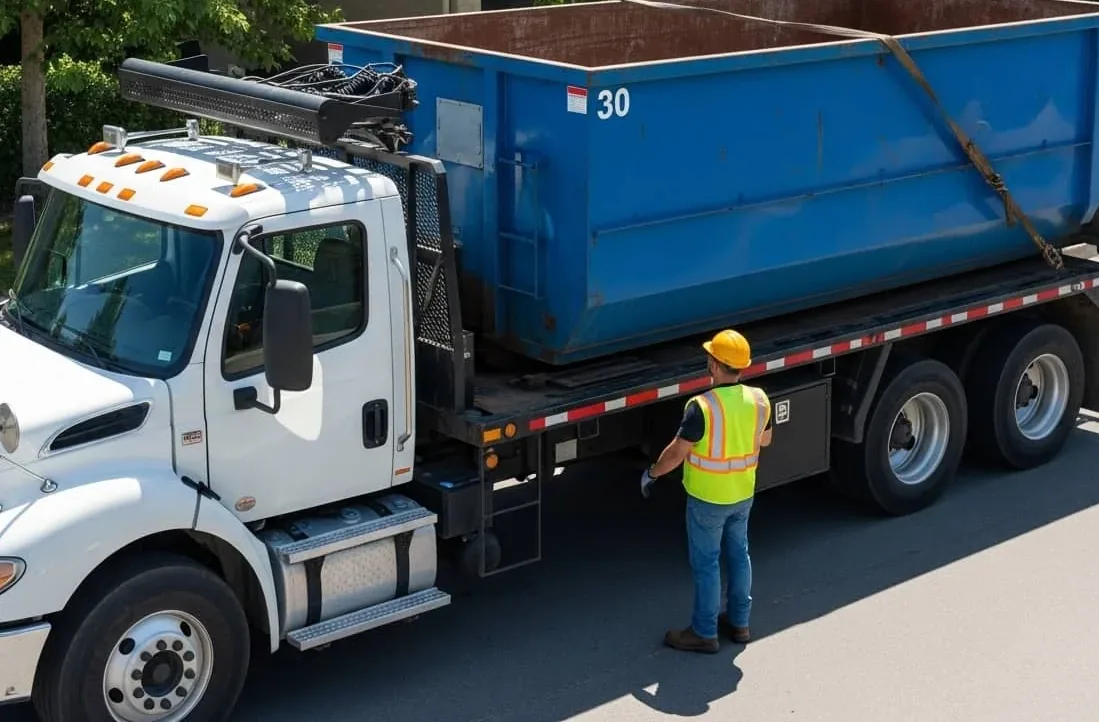
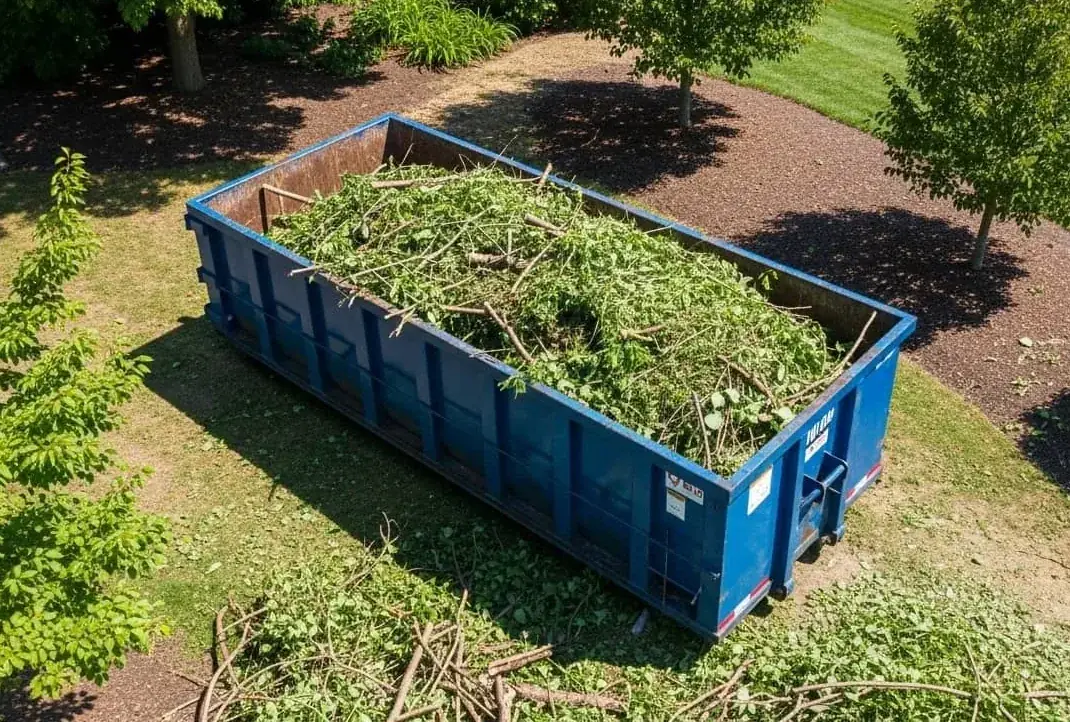
It is the first question almost every caller asks, and it does not have a one-line answer. Cape Cod is fifteen separate towns, each with its own building department, its own fire prevention officer and its own habits about a thirty-yard steel box parked near a road. A little of that is written down and published. Most of it is not.
So here is what we could actually verify, along with the parts we could not. Where a town publishes a rule, it is quoted and linked below. Where nothing is published, this guide says so and tells you exactly who to call and what to ask. After fifteen years of dropping containers from the canal to Provincetown, we would rather hand you a phone number than a confident guess that costs you a fine or a refused delivery.
The short answer depends on where the container sits
On your own driveway, on your own property: in most Massachusetts towns, no street permit applies, because you are not occupying anything public. That is the common case and it is usually straightforward. Two things can still reach onto private ground, though. The first is the state fire code, which is enforced locally and does not care whose driveway it is. The second is a building department that treats the container as part of an active job and wants it addressed on the building permit.
In the street, on a sidewalk, on a shoulder or anywhere in the town right-of-way: assume you need permission before the truck rolls. Towns that regulate this typically want an application a few days ahead, a certificate of insurance, reflectors or lighting so the container is visible at night, cones or barrels around it, and a firm end date. Some charge a fee. Some cap the number of days. On a narrow village lane with no shoulder, the answer may simply be no.
One more piece of Cape geography worth naming: many properties here sit on Title 5 septic systems, and a loaded roll-off must never be staged over a tank, a D-box or a leach field. That is not a permit issue, but it will ruin your week faster than one. Our placement and driveway protection guide covers the ground rules for sand, shell and pea-stone drives.
Falmouth publishes a rule, and it reaches private property
Falmouth is the one Cape Cod town we found with a clear, published, dumpster-specific permit requirement. The town's Fire Prevention dumpster permit page states that a permit is required for any dumpster larger than 6 cubic yards, that the fee is $25, and that the requirement comes from Chapter 19 of 527 CMR 1, the Massachusetts Comprehensive Fire Safety Code.
Read that threshold carefully. Six cubic yards is small. Every standard roll-off — 10, 15, 20, 30 and 40 yard — is well over it, so in Falmouth the permit applies to essentially every container we deliver, including one sitting on a private driveway well back from the street.
A Fire Prevention inspector checks four things: the container is at least 10 feet from the building, it does not obstruct egress, it will not block fire and rescue operations in an emergency, and no flammable or combustible liquids go into it. There is one narrow exception, for dumpsters delivered and removed within a single business day.
What we could not confirm is whether Falmouth also requires a separate DPW right-of-way permit on top of the fire permit for a container placed in a public street. If your box is going anywhere but a driveway, ask about both.
What is published, what is silent, and why that matters
For the other fourteen towns, we went looking and came up empty. Chatham's Streets and Sidewalks chapter covers road layout, betterments, street names and house numbering, with no dumpster or obstruction provision. Barnstable's solid waste chapter and its Obstruction of Public Access article were both checked; the latter deals with waterfront access, not containers in a roadway. Yarmouth publishes a page about the revised state fire code but no dumpster permit page.
Here is the important distinction. Nothing published is not the same as no rule. Plenty of Cape towns handle this through an unwritten counter practice, a condition attached to your building permit, or a fire department that expects a courtesy call. A one-sentence conversation with the building department settles it. Reading a table on a rental company's website does not.
Who to call in each of the fifteen towns
Use the town link for a local overview of what we haul there, and the official site for the department directory and phone numbers.
The department names above reflect how Massachusetts municipalities are normally organized. Titles vary — some towns fold permitting into an inspectional services or licensing office. Start with the building department switchboard and they will point you.
The five questions worth asking when you call
- Does this town require any permit for a roll-off container on private property? Say the size out loud. In a town that follows the 527 CMR 1 threshold the way Falmouth does, six cubic yards is the line, and every roll-off clears it.
- If it has to go in the street or on the shoulder, who issues that permit, what does it cost, and how many business days does it take? Lead time is the answer that actually protects your schedule.
- Do you need a certificate of insurance, and who has to be named on it? We carry insurance and can produce a certificate, but the town has to tell you what wording it wants.
- What has to be on the container at night — reflective tape, lights, cones, barrels? This is the condition people forget, and it is the one that draws a citation.
- Is there a day limit, and what happens if the job runs long? Ask how an extension works before you need one.
Write down the name of whoever answers and the date you called. If they tell you no permit is needed, ask for that in an email. It takes them ten seconds and it ends any argument later.
Route 6, Route 28 and parts of Route 6A answer to the state
This one surprises people. Where a road is a state highway rather than a town road, the town cannot grant you the right to occupy it. MassDOT can. Placement inside a state highway layout falls under the Highway Division's access permitting, governed by 700 CMR 13.00 and handled through the state highway access permit system.
Sections of Route 6, Route 28 and Route 6A are state highway; other stretches, especially through village centers, are town-maintained. The boundary is not obvious from the pavement, and it can change mid-block. If your property fronts one of those roads and the container cannot fit on the driveway or lot, ask the town first whether that section is theirs or the state's, then contact the MassDOT Highway District office covering Barnstable County. We could not confirm the specific process MassDOT applies to a temporary container, so treat that call as a real step and not a formality.
The Old King's Highway district changes the project, not the container
North of Route 6, along the Route 6A corridor from Sandwich to Orleans, sits the Old King's Highway Regional Historic District, created by Chapter 470 of the Acts of 1973. Six towns take part: Sandwich, Barnstable, Yarmouth, Dennis, Brewster and Orleans. There is no single regional website, because there is no single regional office — each participating town elects its own historic district committee, and a regional commission hears appeals.
Barnstable's Old King's Highway committee page describes it as the largest historic district in the nation and lists what the committee reviews: changes to the exterior of buildings and structures, fences and signs, plus new construction and demolition.
A dumpster is not an exterior alteration, so the committee is not reviewing your container. It may well be reviewing the roof, siding, windows or demolition that fills it, and that approval sits ahead of your work in the calendar. In those six towns, get the certificate of appropriateness settled before you book a delivery date.
Condo boards, associations and rental agreements set their own terms
Private rules are private, and they are frequently stricter than anything the town enforces. Condominium associations, homeowner associations and the beach-community associations scattered across Mashpee, Falmouth and Barnstable often restrict where a container may sit, how long it may stay, and whether it may appear at all between Memorial Day and Labor Day. Some private roads are association-owned, which means the association, not the town, controls the shoulder.
None of this shows up in a municipal search. Read the rules or email the property manager, and do it before you commit to a date. A summer rental turnover cleanout is exactly the job most likely to run into a seasonal restriction.
Make the calls before you book, not the morning of delivery
Permits are a scheduling problem more than a paperwork problem. A town that turns around a right-of-way permit in three business days is not slow, but it will absolutely blow up a Monday delivery you arranged on a Friday afternoon. Building departments keep limited counter hours, and from June through August everyone on the Cape is busy at once.
Our order of operations: figure out where the container is going, call the town, get the answer in writing, then call us with a date. If the answer comes back complicated, tell us. A smaller container that fits on the driveway is often the cleanest way around a street permit entirely, and swapping a 30 yard for two hauls of a 20 yard has solved this more than once.
Talk it through with someone who delivers here every week
We will not tell you a permit is unnecessary in a town that has not told us so, and we will not invent a rule to sound authoritative. What we can do is look at your driveway, your road frontage and your project, tell you which container actually fits, and flag the questions worth raising with your town before anything gets scheduled. Licensed, insured and Cape-based since 2011.
Call CC Dumpster Rental Cape Cod at (774) 208-0570 for a flat-rate quote and a straight answer about placement in your town.