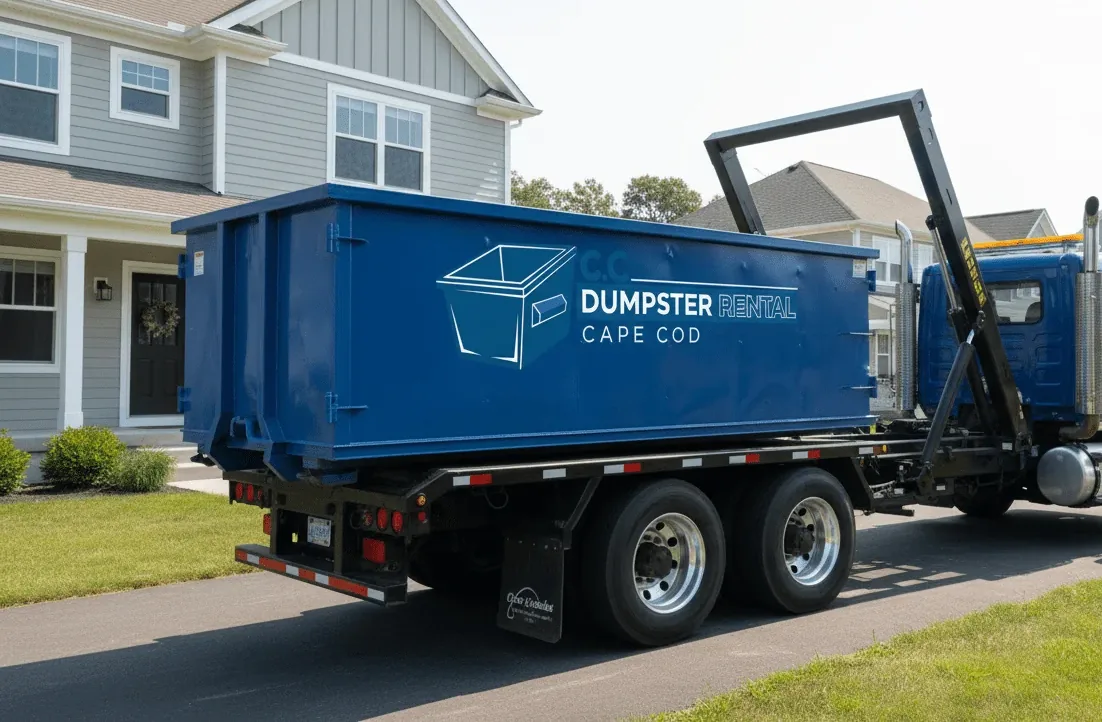
Most people spend real time picking a dumpster size and about four seconds deciding where it goes. That ratio is backwards. Getting the size wrong costs you money. Getting the placement wrong on a Cape Cod property can cost you a septic system.
The Cape is its own case: sandy soil, crushed shell driveways, narrow village lanes, pitch pine hanging over the drive, and one factor almost nobody accounts for. The housing stock here runs overwhelmingly on private on-site septic rather than municipal sewer. Sewer exists in parts of Barnstable, Falmouth, Chatham and Provincetown, but across most of the fifteen towns the wastewater treatment plant for your house is buried in your own yard, very often under the handiest place to set a container.
The septic system is the first thing to think about, not the last
A Massachusetts on-site system built under Title 5 has three parts that matter for placement: the septic tank, the distribution box (everyone calls it the D-box), and the leach field. Solid pipe runs house to tank, tank to D-box, and perforated laterals fan out into the field. All of it sits shallow. Tank covers are commonly six inches to two feet down. The D-box is a small concrete or plastic box with thin walls and a thin lid, and it is the most fragile component in the assembly.
Set several tons of loaded steel on that, with the weight concentrated through two container rails and a set of truck wheels, and you can crack a tank cover, shear an inlet or outlet tee, or collapse a D-box outright. A collapsed D-box stops splitting flow evenly, one lateral takes everything, and the field drowns. Compaction over the field is a slower version of the same problem, because a leach field only works by letting effluent percolate through unsaturated soil. The EPA's homeowner guidance is not subtle: do not park or drive on your drainfield, because vehicle weight compacts soil and damages pipes.
What makes this worth leading with is who pays. A full Title 5 replacement on the Cape is routinely a five-figure job, and no hauler's insurance covers a container set precisely where the customer pointed.
How to find your system before the truck arrives
Skip the guesswork. Under Title 5 (310 CMR 15.000), septic systems are permitted and approved by the local Board of Health, and towns keep both the approved design plan and the post-installation as-built on file. The Town of Barnstable Health Division holds records for systems installed after 1974 and will give a property owner a copy of the as-built card. Other Cape towns work the same way. Mass.gov keeps a plain-language summary of Massachusetts Title 5 law and septic systems if you want the underlying rules.
Ask specifically for the as-built. It is a scaled sketch showing tank, D-box and field measured off fixed points, usually house corners. Half an hour with a tape and a can of marking paint tells you which third of the yard is off limits. If the house predates local records, a septic pumper can locate and probe the tank for a modest fee, and the field is almost always downstream of it.
The working rule: keep the container and the truck's entire path off the tank, the D-box, the field, and the pipe run connecting them. That last one catches people. The straight shot between house and tank is shallow solid pipe, and tires cross it far more often than anything sits on it.
What a loaded roll-off actually weighs
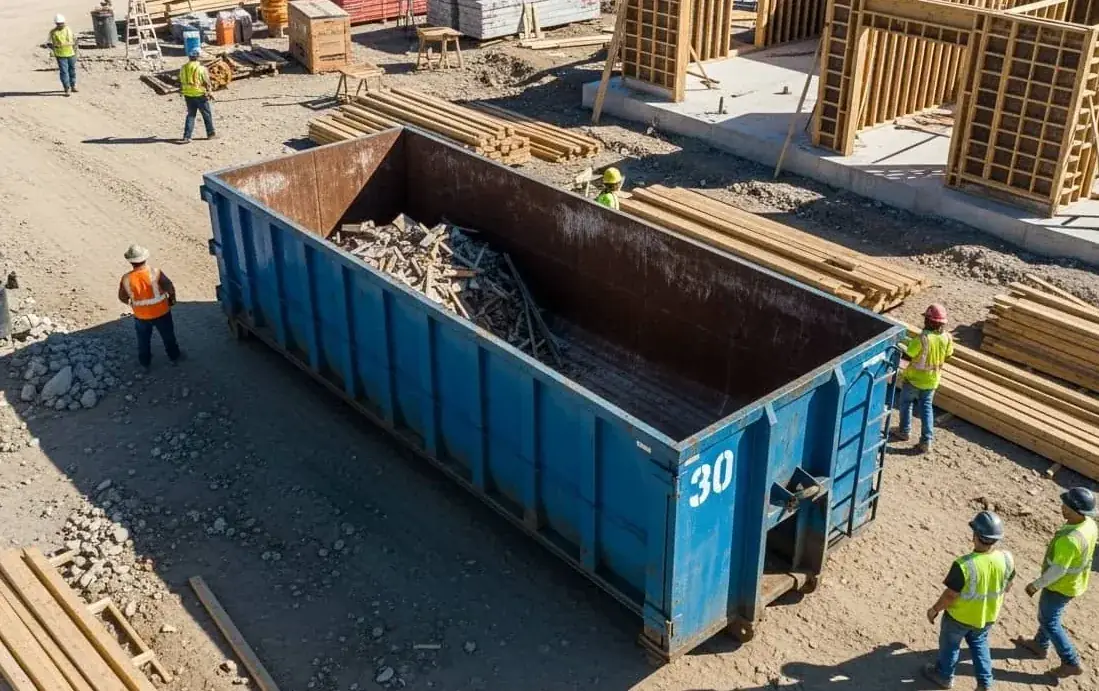
Empty containers run roughly 3,750 to 6,500 pounds depending on size. Add a typical residential load and you are at five to eight tons. Add roofing shingles, plaster and lath from an antique Cape, or anything masonry, and ten tons is ordinary. The delivery truck, loaded, weighs considerably more than the container, and on a hot August afternoon all of it rides on softened asphalt.
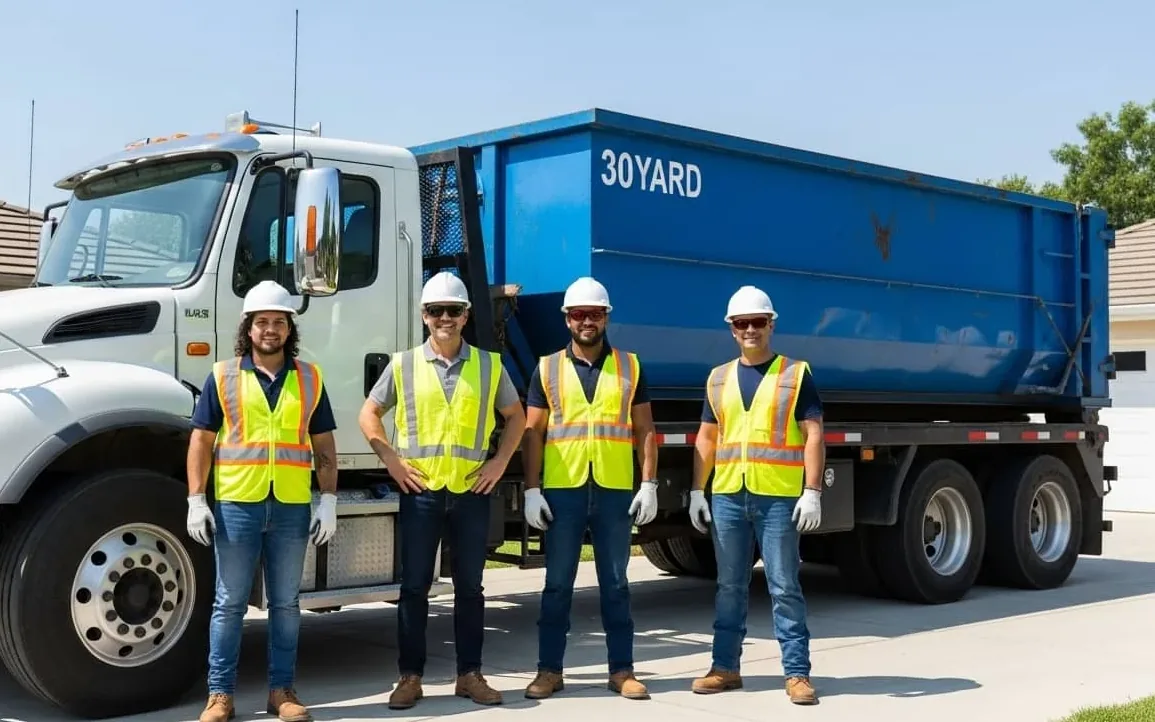
If capacity is still open, the Cape Cod size guide works through it and our size lineup lists footprints. Footprint matters as much as volume here. A 10 yard container fits a short Dennis driveway with room to spare; a 30 yard container needs a long straight run and puts far more weight on whatever is underneath.
Cape driveway surfaces and how each one fails
Every surface reacts differently to a concentrated load. Know which one you have before delivery day.
Plywood cribbing, and why the drop and the pickup do the damage
The container sitting still is rarely the problem. Damage happens in two brief moments: when it rolls off the truck and the rollers or rails contact the surface, and when the winch cable drags it back on loaded. In both, full weight transfers through a small contact area while the container is moving.
The standard answer is plywood cribbing. Two-foot squares of three-quarter-inch exterior plywood under each rail at the front and rear contact points, plus a set in the truck's rear wheel path. Two-by-two is the practical size, big enough to spread load and light enough to place and reposition by hand. Three-quarter-inch stock bridges without snapping; thin luan cracks on the first roll.
Lay the boards before the truck arrives and tell the driver they are there, so the rails land on them rather than beside them.
Look up before you look down
To unload, the truck tilts its bed and raises the container's front end high. That is the part homeowners never picture. Plan on well over twenty feet of unobstructed vertical clearance for a standard roll-off, and more for a 20 yard or larger box. Fifteen feet is not enough.
Things that quietly disqualify a spot: low pitch pine and oak limbs, the electric service drop from pole to house, cable and phone lines, gutters and fascia, a low overhang on a one-story cottage, a carport, a basketball hoop. Stand where the container will sit and look straight up. If a branch would be brushed by a container standing on end, it will break, and if the service drop is in the arc, the spot is unusable.
The approach: straight run, turning room and narrow lanes
A roll-off truck delivers by backing straight in. As a planning figure, allow roughly sixty feet of straight run behind and including the container position for a mid-size box, plus about ten feet of width to line up.
Soft shoulders are a Cape specialty. Sandy edges beside a paved drive look solid and are not, and rear duals dropping off the pavement is how trucks get stuck. Narrow village lanes deserve a conversation before booking: the streets around Woods Hole village, the older lanes off Wianno Avenue in Osterville, and the West End of Provincetown, where some streets are barely wider than the truck and parked cars take the rest. There, placement often becomes street placement, which brings a permit into it. Our town-by-town permit guide covers who requires what.
Irrigation, wells, propane and buried oil
Septic is the headline, but Cape yards hold plenty else underground. Irrigation heads sit flush in the lawn and vanish in June growth, and the laterals are shallow poly that crushes easily. Private well heads and supply lines are common in towns without municipal water. Add propane tanks and their gas runs, buried oil fill and vent lines on older properties, and underground electric to a detached garage or shed.
For anything utility-owned or in the public way, Massachusetts law requires Dig Safe 811 notification with 72 hours advance notice, weekends and holidays excluded. Worth understanding: Dig Safe is a clearinghouse that notifies member utilities, and those utilities mark only what they own. Private lines past the meter, including irrigation, pool gas and power to outbuildings, go unmarked unless you hire a private locator.
Lawns, slope and the season you are in
Lawn placement is almost always a mistake. Turf over sandy soil carries no useful load, the container sinks and leaves a rectangular depression that lasts a season, and the truck crosses more lawn to reach it. Wet conditions mean ruts you regrade in the spring. The exception is a large open property with firm, level, well-drained ground and an owner who has accepted the cosmetic cost.
Level matters more than people expect. A container on a slope loads unevenly, doors swing hard or refuse to latch, and debris shifts to the low end. A side slope is worse than a front-to-back slope, and nothing should sit uphill of a house, a pool or a septic tank.
Season changes the math. Frozen ground in January carries weight beautifully. Mud season does the opposite, and a saturated sandy drive after a nor'easter will not hold a loaded truck. Snow hides everything you marked, so stake the corners of the placement area tall enough to see. Shoulder months are also when residential rentals schedule around your convenience rather than the calendar's.
Your pre-delivery walkthrough
Do this the day before, not the morning of. It takes fifteen minutes.
- Pull your septic as-built from the town Board of Health, or call a pumper to locate the tank. Mark the tank, D-box and field with paint or flags.
- Confirm nothing in the septic footprint, including the pipe run from the house, sits under the container or the truck's path.
- Identify the driveway surface and buy or borrow four to six two-foot squares of three-quarter-inch plywood.
- Stand at the spot and look straight up. Check limbs, service drops, cable lines, gutters and overhangs in the lift arc.
- Measure the straight run behind the spot and check width at the pinch points.
- Flag irrigation heads, the well head, propane tanks and buried fuel lines along the approach.
- Confirm the ground is level and firm. If it rained hard, consider moving the date.
- Clear the area: vehicles, boats, trailers, barrels and the basketball hoop. Warn the neighbors if the truck needs the street.
- Lay the plywood, then mark the exact container position with cones, stakes or paint so the driver is not interpreting.
- Be reachable by phone during the delivery window. Most placement problems are solved in a thirty-second call from the cab.
If you want a second set of eyes, say so when you book. We have been placing roll-off containers on Cape driveways since 2011, and our drivers will tell you honestly when a spot is wrong before they commit to it.
Ready to schedule, or want to talk through a tricky driveway first? Call CC Dumpster Rental Cape Cod at (774) 208-0570 and describe the property. We will help you pick the right size, the right spot and the right day, and quote a flat rate on the same call. Hours and service area are on the contact page.