
Clearing a Family House on Cape Cod: A Practical Estate Cleanout Guide
Clearing a family house on Cape Cod, done in the order that actually works: secure the house and paperwork first, triage room by room, and bring the container in last.
ReadStorm & Emergency guide
Most homeowners damage their own insurance claim by hauling debris out before documenting it. Here is the right order of operations for Cape Cod storm cleanup, plus how to sort the pile.
The most expensive mistake people make after a Cape Cod storm is not a structural one. It is throwing the ruined sofa, the soaked insulation and the dead refrigerator on the curb at 7 a.m. the next morning, before a single photograph exists and before the insurer has a claim number on file. The debris is gone, the proof is gone, and the settlement shrinks to whatever the adjuster is willing to take on faith.
Order of operations is the whole game. Safety first, documentation second, disposal third. Do it in that sequence and the cleanup goes smoothly. Do it out of order and you spend the next three months arguing about a pile that is already at the landfill.
Nothing below matters if somebody gets hurt. After a nor'easter or a tropical system clears the Cape, the hazards are usually invisible until you are standing on top of them.
Downed wires are live until a utility crew says otherwise. Never move them, never drive over them, never pull a branch off one. That includes lines lying in standing water, which can energize the water around them. Massachusetts emergency officials are blunt about this: assume every downed wire is energized, keep everyone back, call 911, then report it to your electric utility. MEMA's post-disaster guidance is the plain-language version worth reading before you go outside.
Gas smell means leave. Do not flip a switch, do not start a generator, do not light anything. Get out, then call from a distance.
Standing water is not clean water. Flood water on the Cape routinely carries fuel oil from a tipped tank, septic overflow from a saturated leach field, and enough broken glass to end your day. Stay out of moving water entirely.
If you doubt the structure, do not test it. A sagging ceiling, a wall that moved, a roof with sky showing through it — those are inspector questions, not homeowner questions.
Generators go outside, well away from windows and doors. Every year somebody survives the storm and gets hurt by the cleanup.
Insurers are not trying to trick you, but they can only pay on what can be substantiated. Photographs are cheap; a denied line item is not. The pattern that works:
None of this is insurance advice, and we are not adjusters. Treat it as the list of questions to bring to your own insurer: what does my policy cover here, what do you need from me, and what am I cleared to dispose of before you inspect? The Massachusetts Division of Insurance also publishes consumer guidance on the claims process that is worth reading alongside your policy.
Wet porous material starts growing mold quickly — the EPA notes that wood, drywall, carpet and furniture can grow mold if they stay wet more than 24 hours. A week of waiting can turn a water claim into a mold problem. Pitching everything first undercuts the claim.
The workable middle: remove what is a health hazard, document it thoroughly first, and stage it where the adjuster can still see it if possible. Generally safe to pull immediately once photographed — saturated carpet and pad, wet fiberglass insulation, soaked upholstered furniture, water-damaged drywall, spoiled food, and anything visibly molding. Generally worth leaving in place — structural framing, roofing and siding damage, damaged appliances and mechanicals, and high-value contents. Confirm the split with your insurer rather than guessing.
Anyone on a marsh edge in Chatham or a low lot in Wellfleet knows storm surge behaves differently than a burst pipe. Salt is conductive and corrosive, and it does not evaporate when the water does. It stays in the material.
Wiring and devices touched by saltwater corrode from the inside and can fail months later. Salt-soaked fiberglass and cellulose holds moisture against framing indefinitely and should be treated as a loss. Appliances and HVAC equipment that took salt water often cannot be returned to service, and fasteners and connector plates start rusting on a schedule you cannot see. Flag saltwater intrusion explicitly to your insurer and to any electrician or HVAC tech who comes out. The remediation standard is different from freshwater, and the difference shows up in the estimate.
This is where money leaks. Debris from one storm splits into streams that go to different destinations at different rates. Mix them and you get charged at the highest rate for the whole load, or the load gets rejected. Sorting as you carry costs nothing; sorting after the fact costs a day.
| What it is | Where it actually goes | Keep it separate because |
|---|---|---|
| Brush, limbs, whole trees, leaves | Composting or wood-processing facility, or a town brush drop-off | Banned from disposal in Massachusetts; must stay clean and free of trash, wire and plastic |
| Shingles, siding, sheathing, trim, fence | Construction and demolition processing facility | Sorted and recovered differently; heavy, so tonnage matters |
| Furniture, rugs, toys, general household contents | Bulky waste or municipal solid waste stream | Mattresses and textiles are separately banned and need their own path |
| Refrigerators, freezers, AC units, dehumidifiers | Appliance recycling with refrigerant recovery | Refrigerant must be removed by a certified tech before the unit is scrapped |
| Fuel, propane tanks, paint, pool chemicals | Household hazardous waste collection | Never goes in a container, ever |
| Wet drywall, insulation, carpet and pad | Construction and demolition, kept out of the brush pile | Water weight is real; wet material can double a load's tonnage |
If you want the longer version of what is and is not allowed, we keep a running list in our guide to what can and cannot go in a dumpster.
Leaves and yard waste are on the MassDEP waste disposal ban list, along with treated and untreated wood. Practically, that means your brush pile has to stay genuinely clean — no tarps, no rope, no chicken wire, no bagged trash tossed in for convenience. One contaminated load and the whole thing gets bounced back to a mixed-waste rate.
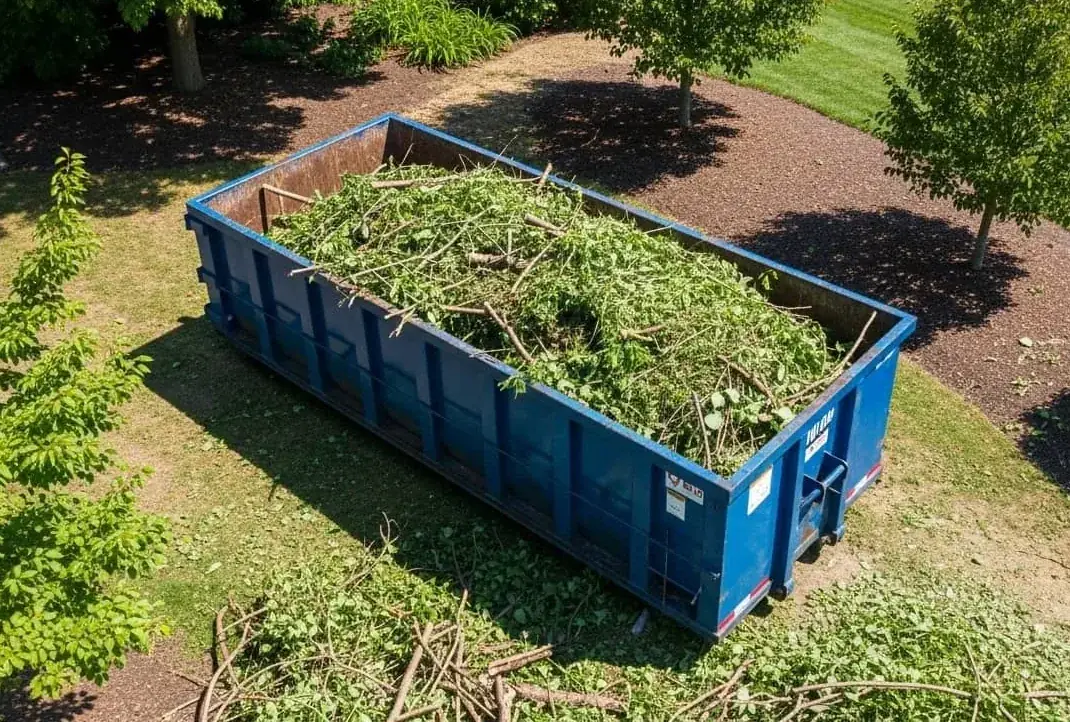
Cape storms take down pitch pine and scrub oak by the acre. Pitch pine is brittle and drops big limbs; scrub oak comes down in tangled masses that occupy enormous volume for very little weight. That is the trap. A container of unprocessed brush is mostly air, and you pay to haul air. Chipping first, then loading chips and cut rounds, typically triples what fits. If the volume is real, pair the chipper with a 30 yard container for the bulk and keep a smaller one for the house contents. Our yard waste removal service handles the clean brush stream, and the brush disposal guide covers the year-round rules.
Wind damage rarely stays tidy. Cedar shingles peel in patches, asphalt tabs lift and crack without visibly blowing off, and the leak shows up two rainstorms later. Photograph the roof from the ground with a zoom before anyone climbs it, and again after the tarp goes on. A storm tear-off fills faster than owners expect. A 20 yard container handles most single-family re-roofs, our roofing dumpster rental is set up for the weight, and the tear-off guide has the square-footage math. Fencing is its own category: pressure-treated posts, vinyl panels and concrete footings are three materials, and the concrete is heavy enough to matter for tonnage. Pull the hardware, keep the concrete separate, and mention it when you book.
After a significant event, some Cape towns organize a separate curbside pickup for storm debris. Two things to understand first. It is almost always vegetative material only — brush and limbs, not shingles, not furniture, not the contents of your basement. And it usually applies to material placed in the public right-of-way, not hauled out from the back of the property. Check your town website or DPW directly; the rules and the window differ town by town and change with each storm. Anything outside that narrow definition is on you, which is where storm debris removal fills the gap.
When a named storm hits Barnstable County, every hauler from Bourne to Provincetown books solid within hours and stays that way for a week or more. Bridge traffic slows deliveries. Transfer stations run long lines. There is no version of this where everyone gets a container on day one.
The customers who get served are the ones who called first. Not the ones with the worst damage, not the ones who waited to see what the adjuster said — the ones who picked up the phone while the wind was still blowing. Book the container early, even if you are not sure of the exact size yet. Sizes can be adjusted; a place in the queue cannot be created after the fact.
We have run storm cleanups across the Cape since 2011, and the pattern repeats every time: photograph first, sort as you go, call early. Reach CC Dumpster Rental Cape Cod at (774) 208-0570 for a flat-rate quote with delivery, pickup and disposal included, and tell us what came down. We will be straight with you about what we can get there and when, and which container fits your mix of brush, building material and contents. Same-day and next-day delivery when the schedule allows, and our contact page has hours and service area.
Talk to a real person
Call (774) 208-0570 and describe the job. Flat price, stated tonnage allowance, and a delivery window on the same call.
Mon–Sat 7:00am – 6:00pm · Sun by appointment
From this guide
<p>Ask your insurer first, and get the answer in writing. Most carriers will let you remove material that is an active health hazard — soaked carpet and insulation, spoiled food, anything already molding — as long as you photograph it thoroughly first and keep a sample. Structural damage, appliances and high-value contents are usually best left in place until the inspection. Open the claim, note the claim number and the adjuster's name, and confirm the disposal question directly rather than assuming.</p>
<p>Salt stays behind after the water dries. It is conductive and corrosive, so wiring, connectors, fasteners and circuit boards touched by storm surge can corrode internally and fail months later. Salt-soaked insulation holds moisture against framing indefinitely, and appliances or HVAC equipment that took salt water frequently cannot be restored. Tell your insurer, your electrician and your HVAC tech explicitly that it was saltwater, because the remediation standard is different.</p>
<p>Sometimes, after a significant event, but the program is usually narrow. It is typically vegetative material only — brush and limbs, not shingles, siding, furniture or basement contents — and it typically covers material placed in the public right-of-way rather than hauled from the back of a property. The window and the rules change with each storm and vary by town, so check your town website or DPW directly before you count on it.</p>
<p>They go to different facilities at different rates. Leaves and yard waste are banned from disposal in Massachusetts and have to reach a composting or wood-processing site clean — no tarps, rope, wire or bagged trash mixed in. Construction debris goes to a C&D processing facility. If the streams get mixed, the load is either rejected or charged at the highest applicable rate, so sorting as you carry material out is the cheapest sorting you will ever do.</p>
<p>Honestly, it depends entirely on when you call. Demand across Barnstable County spikes within hours of a major storm and stays high for a week or more, and bridge traffic slows every delivery. The customers who get served first are the ones who booked first, not the ones with the worst damage. Call as early as you can, even before you know the exact size — sizes can be changed later, but a spot in the queue cannot be backdated.</p>
Keep reading
Clearing a family house on Cape Cod, done in the order that actually works: secure the house and paperwork first, triage room by room, and bring the container in last.
ReadVolume and weight are two separate limits, and the one that stops you first depends on the material. A Cape Cod sizing guide with real dimensions, debris weights and worked examples for every roll-off size.
ReadA loaded roll-off can weigh ten tons on a small footprint, and most Cape Cod homes sit on private septic. Here is how to place one without wrecking a tank or a driveway.
Read