
Cape Cod service
Concrete and Heavy Debris Dumpsters on Cape Cod
Broken concrete, brick, block, asphalt, stone and fill hauled from any Cape Cod property. Clean loads go to recycling, and we size the box for weight.
- Licensed & insured
- Same-day on the Upper Cape
- Flat-rate pricing
- All 15 Cape towns
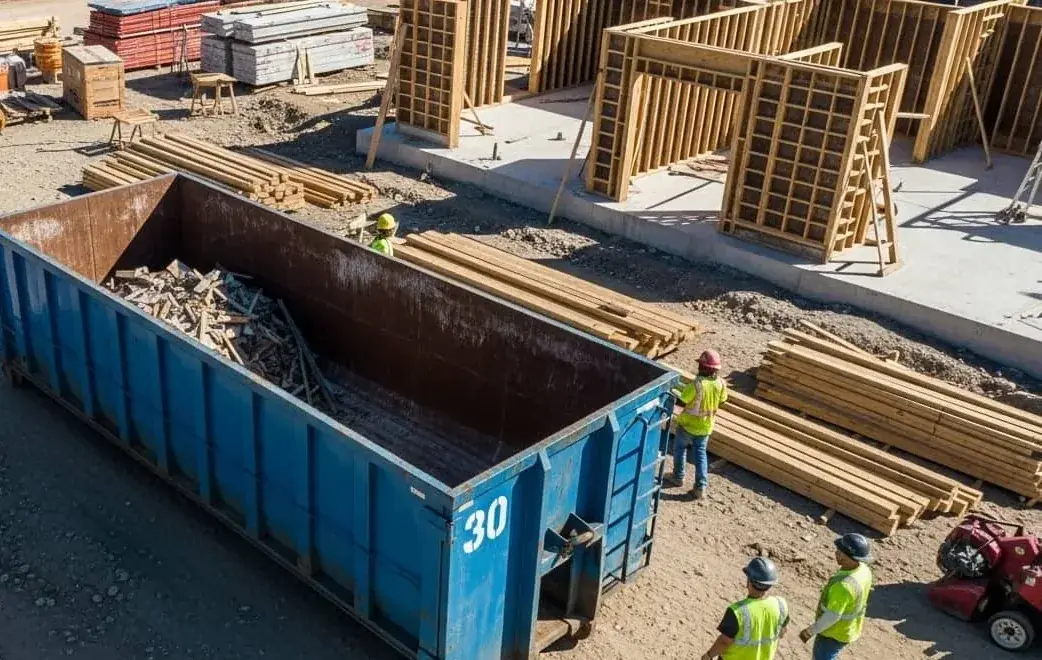
Concrete & Heavy Debris across all fifteen Cape Cod towns
Heavy debris breaks every rule of thumb people use for dumpsters. A homeowner who has rented a 20 yard box for a garage cleanout looks at a patio slab and thinks the same container will do. It will not. Five cubic yards of broken concrete weighs more than a full 30 yard container packed with household furniture, and no truck on Cape Cod can lift a 10 yard box loaded to the rim with slab.
Concrete, brick, block, asphalt, stone, tile, dirt and sand are priced and hauled by weight rather than by space. That changes the container, the fill line and the way the load is sorted. It also opens a door: Massachusetts bans asphalt pavement, brick and concrete from disposal, and a clean load of those three materials goes to a crushing or recycling operation rather than a landfill. Keeping the load clean is worth real money. We have been hauling heavy debris across Barnstable County since 2011 and the sizing conversation takes about ninety seconds on the phone. It is worth having before you swing the first hammer.
At a glance
What you get with concrete & heavy debris
- Heavy debris is limited by weight, not volume, so the box is smaller than people expect
- A 10 yard container filled a third to halfway is the standard call for clean concrete
- Massachusetts bans asphalt pavement, brick and concrete from disposal, so clean loads are crushed and recycled
- Clean means unpainted, uncoated and unmixed; rebar in concrete is fine, general trash on top is not
- Broken concrete runs roughly 2,000 to 4,000 pounds per cubic yard, one to two tons
- Dirt, sand and sod belong with heavy debris rather than in a yard waste container
- Plywood cribbing goes under the rails on every heavy delivery to protect shell, stone and asphalt driveways
- A loaded container must never sit over a Title 5 tank, distribution box or leach field
Why Heavy Debris Follows Different Rules
Every roll-off has two limits. One is volume, the number of cubic yards the box holds. The other is weight, set by what a truck can legally lift and carry on the road. For ordinary household and construction debris, you hit the volume limit first, which is why people think in yards. For concrete, brick, asphalt, stone and dirt, you hit the weight limit long before the box looks full.
That single fact drives everything else. A small container is not a compromise on a heavy job, it is the correct tool. A 10 yard box has a low side wall, which means you can walk chunks in over the rail rather than lifting them chest high, and it means the load reaches its weight allowance while there is still room to see what you are doing. Larger boxes on a concrete job are actively worse: taller walls, harder loading, and a permanent temptation to keep filling past the point where the load can leave.
The other reason to think in weight is what happens underneath. A container holding six or eight tons puts a concentrated load through four small contact points onto a driveway. On the sandy soil, crushed shell and pea-stone surfaces common across the Cape, that is enough to sink rails and rut a surface that looked solid in the morning. The 10 yard container is what we bring to almost every heavy debris job for exactly these reasons.
What a Cubic Yard of This Material Actually Weighs
The numbers below are approximate and vary with moisture, thickness and mortar content. They are close enough to plan a job around.
| Material | Approximate pounds per cubic yard | Approximate tons per cubic yard |
|---|---|---|
| Broken concrete (slab, walk, foundation) | 2,000 to 4,000 | 1 to 2 |
| Brick and block with mortar attached | 2,500 to 3,200 | 1.25 to 1.6 |
| Broken asphalt pavement | 2,000 to 3,800 | 1 to 1.9 |
| Dirt, loam and soil (dry to saturated) | 2,000 to 3,000 | 1 to 1.5 |
| Sand (dry to damp) | 2,400 to 3,200 | 1.2 to 1.6 |
| Stone, gravel and cobble | 2,600 to 2,900 | 1.3 to 1.45 |
Now translate that. Take broken concrete at a middling 3,000 to 4,000 pounds per cubic yard. Five cubic yards, which is a 10 yard container filled exactly halfway, comes to 15,000 pounds. That is seven and a half tons sitting on your driveway, and it is at or near what a single roll-off truck can legally lift and carry off a Cape road.
Fill that same box to the top rail and you are asking for fifteen tons. Nobody hauls that in one trip. The container gets left, the load gets dug out by hand, and everyone loses a day. This is why a 10 yard filled between a third and halfway is the right call on clean concrete, and why we mark the fill line before we leave. On lighter heavy debris such as tile or thin brick, halfway to two-thirds is realistic. Ask when you book and we will give you a level rather than a guess.
The Massachusetts ABC Ban and the Value of a Clean Load
Massachusetts bans asphalt pavement, brick and concrete from disposal. The three materials are grouped together in the regulations as ABC rubble, and they appear on the MassDEP waste disposal ban list alongside metal, clean gypsum wallboard, leaves and yard waste, mattresses and textiles. A landfill or transfer station cannot knowingly accept them for disposal.
What happens instead is better for everyone. Clean ABC rubble goes to an asphalt plant or a crushing operation, where it is processed into aggregate and reused as base material, fill or new pavement. Processing clean rubble typically costs less per ton than disposing of mixed debris, so a segregated load is cheaper than a contaminated one.
The catch is what counts as clean. MassDEP guidance is strict: the rubble cannot be painted, coated or impregnated with any other substance, and it cannot be mixed with or contaminated by other wastes. In practice that means concrete with rebar in it is fine, and concrete with a layer of sheet vinyl bonded to the top is not. A pile of block with mortar is fine. The same pile with two bags of construction trash, a roll of poly and a broken window thrown on top is no longer a recyclable load.
So keep heavy debris in its own container. If your project generates both, run a small heavy box for the concrete and a larger one for everything else through demolition debris removal. MassDEP publishes detailed guidance on handling ABC rubble if you want the rules directly.
Dirt, Sand and Fill: The Cape's Own Problem
Soil is the material people most often get wrong here, partly because the Cape sits on sand and it seems harmless. It is heavy. A cubic yard of dry soil runs around a ton, and saturated soil after a wet week runs closer to a ton and a half. A heaped pickup bed of loam is well over a ton, which most half-ton trucks should not be carrying.
Dirt also has to be honestly described. Clean fill is soil, sand and stone with nothing else in it. Once roots, sod, asphalt chunks, wire or general trash are mixed in, it is no longer clean fill and it goes elsewhere at a different cost. Sod is the classic example: people assume it is yard waste, but it is close to half soil by weight, so it belongs with heavy material rather than a brush container.
There is a second issue worth raising. Soil from around old oil tanks, or from any excavation that turns up staining or a fuel smell, may need testing before it can move off site. That is not common on residential jobs, but it is not rare on properties with buried tanks. If you turn up discolored or oily soil, stop and call rather than loading it.
For ordinary excavation, garden bed removal, sandy fill and old stone, a 10 yard box filled low handles more than people expect. Ten cubic yards of anything on this list is over ten tons, so the fill line matters more than the container size.
Driveways, Septic Systems and Where a Heavy Box Can Sit
Placement is a bigger deal on heavy jobs than any other kind. A loaded concrete container concentrates several tons on a small footprint, and the surfaces the Cape is built on do not forgive that.
Crushed shell, pea-stone and sand driveways compress and rut under a loaded box. Asphalt softens in July and takes a permanent impression. Pavers and brick aprons crack. We set plywood cribbing under the rails and under the wheel path on every heavy delivery, which spreads the load and usually prevents damage outright. On a soft or newly graded surface we will tell you honestly if we think the spot is a bad idea before we set the box down.
Septic is the serious one. Cape properties run on Title 5 systems, and the tank, distribution box, and leach field are frequently under the parking area or the side yard. A loaded roll-off must never sit over any part of that system. Tank covers crack, D-boxes shift, and leach field piping collapses under weight it was never designed for, which turns a patio job into a five-figure septic repair. If you do not know where your system is, the as-built plan is on file with the town health department and is worth pulling before delivery day.
Soft shoulders, sandy lanes and narrow roads matter too, especially in the Outer Cape villages. A loaded truck is heavy on the way out. Our placement and driveway protection guide covers what we look for when we pull in.
Patios, Walkways, Chimneys and Foundations: Real Jobs
Numbers make more sense against actual work. Here is what typical Cape heavy debris jobs produce.
A 12 by 16 foot concrete patio, four inches thick, is about 2.4 cubic yards of concrete. Broken up, it loosens to roughly 3 cubic yards and lands somewhere near four to five tons. That is a 10 yard container filled about a third, and it is a full day of work with a jackhammer for two people.
A 60 foot walkway, three feet wide and four inches thick, comes out around 2.2 cubic yards broken. Similar container, similar load.
A brick chimney taken down to the roof line on an older Cape typically yields 400 to 800 bricks, plus mortar. At roughly 4.5 pounds per brick with mortar attached, that is one to two tons, and it loads far more compactly than slab because the pieces are small and uniform.
An asphalt driveway apron or a section of parking area runs close to concrete by weight. A 400 square foot section at two inches thick is around 2.5 cubic yards and three to four tons broken out.
A full foundation removal or a poured cellar floor is a different scale entirely and usually means multiple staged containers or a machine and a live load. Those we schedule as a project rather than a rental. Talk to us about construction container service if a contractor is running the site, and see the Cape Cod size guide for how these compare with ordinary loads.
Suitability
Is concrete & heavy debris the right call?
The fastest way to get this right is to check the load against both lists before you book.
Good fits for this container
- Concrete patio, walkway, step and slab removal
- Brick and block demolition, including chimneys taken down to the roof line
- Asphalt driveway aprons, parking sections and walkway removal
- Stone walls, cobble, fieldstone and old retaining wall material
- Ceramic and porcelain tile tear-out from bathrooms and kitchens
- Clean fill, excavated soil, sand and sod from small site work
- Small foundation, footing and cellar floor breakouts
Send these somewhere else
- Painted, coated or sealed concrete and brick, which fall outside the clean ABC rubble rules
- Heavy debris mixed with wood, drywall, roofing, plastic or household trash
- Soil that is discolored, oily or came from around an old fuel tank without testing
- Containers filled above the marked fill line, which cannot legally be hauled
- Asbestos-containing floor tile, mastic and transite pipe
- Wet concrete washout, slurry or uncured mix
Sizing
Which container for concrete & heavy debris?
Every size below runs on this service. Match the material to the weight allowance and the volume takes care of itself.
- 10 yard — The default for clean concrete, brick, asphalt, stone and dirt. Filled a third to halfway, roughly 3 to 5 cubic yards.
- 15 yard — Lighter heavy debris such as tile, thin brick or a mixed load with a modest masonry fraction. Still filled low.
- 20 yard — Only for demolition debris where masonry is a small part of a mostly bulky, lighter load. Not for clean slab.
- 30 yard — Bulk demolition where framing, siding and interiors dominate and a little masonry rides along. Never a concrete box.
- 40 yard — Light, high-volume demolition only. Heavy debris in a 40 yard cannot be filled far enough to be worth the container.
| Size | Dimensions | Capacity | Weight included | Best for |
|---|---|---|---|---|
| 10 Yard Dumpster | typically about 12 ft long × 8 ft wide × 3.5 ft high | about 3-4 pickup truck loads | 1-2 tons | Heavy, dense debris and tight driveways: concrete, brick, tile, one-room gut. |
| 15 Yard Dumpster | typically about 16 ft long × 8 ft wide × 4 ft high | about 4-6 pickup truck loads | 2 tons | Two-room remodels, garage and shed cleanouts, small roof tear-offs. |
| 20 Yard Dumpster | typically about 22 ft long × 8 ft wide × 4.5 ft high | about 6-8 pickup truck loads | 2-3 tons | Full roof replacement, whole-floor renovation, three or four bedroom cleanout. |
| 30 Yard Dumpster | typically about 22 ft long × 8 ft wide × 6 ft high | about 9-12 pickup truck loads | 3-4 tons | Cottage gut renovation, whole-house estate cleanout, storm debris, demolition. |
| 40 Yard Dumpster | typically about 22 ft long × 8 ft wide × 8 ft high | about 12-16 pickup truck loads | 4-5 tons | Structural demolition, commercial and multi-unit work, high-volume bulky debris. |
Concrete & Heavy Debris — the Cape Cod specifics
Two Cape realities shape heavy debris work. The first is what is under the driveway. Sand and pea-stone are common, water tables run high in low-lying areas, and Title 5 septic components are often directly beneath the space where you would naturally want a container. The health department at your town hall holds the as-built plan for your system, and pulling it before delivery day is fifteen minutes well spent.
The second is access. Everything crossing onto the Cape goes over the Bourne or Sagamore bridge, and once you are past them the roads narrow quickly. Village lanes off Route 6A, the Outer Cape roads, and older neighborhoods in Falmouth and the Barnstable villages have soft shoulders and tight turns that a loaded truck has to respect. Smaller containers are not just a weight decision here, they are often the only thing that fits.
MassDEP's guidance on managing construction and demolition wastes is the authority on how this material is handled statewide, and our cost guide explains how tonnage figures into a flat rate.
Talk to a real person
Need concrete & heavy debris on Cape Cod?
Call (774) 208-0570, describe the job in a sentence, and you will get a flat price and a delivery window on the same call.
Mon–Sat 7:00am – 6:00pm · Sun by appointment
Answers
Concrete & Heavy Debris — your questions answered
Why can't I put concrete in a 20 or 30 yard dumpster?
Because the weight arrives long before the space runs out. Broken concrete averages somewhere between a ton and a half and two tons per cubic yard, so a 20 yard box even half full is fifteen tons, well past what a roll-off truck can legally lift and carry. The container would sit on your driveway until it was emptied by hand. A 10 yard filled a third to halfway holds the same amount of concrete a truck can actually take away in one trip.
Can I mix a little wood and trash in with the concrete?
It is better not to. MassDEP rules on asphalt pavement, brick and concrete require the material to be free of contamination to go to a crushing or recycling operation, and once wood, drywall, plastic or bagged trash goes in, the whole load is reclassified and priced as mixed debris. If your project makes both kinds of waste, the usual answer is a small heavy box and a separate larger one. Call and we will set both up.
How much concrete fits in a 10 yard container?
Roughly 3 to 5 cubic yards depending on thickness and how it breaks, which is a fill level between a third and halfway up the wall. In slab terms that is about 250 to 400 square feet of four-inch patio or walkway. We mark the fill line on delivery so nobody has to guess. If your project runs past that, a second container or a swap on the same day is straightforward and cheaper than an overloaded box.
Is dirt treated the same as concrete?
By weight, essentially yes. Soil runs about a ton per cubic yard dry and closer to a ton and a half saturated, so it goes in a small container filled low just like masonry. Where it differs is destination and description. Clean fill with nothing mixed in has good outlets. Once roots, sod, trash or debris are in it, it becomes a different material. Soil from around an old fuel tank may need testing before it can move.
Will the container damage my shell or pea-stone driveway?
Not if it is set correctly. We put plywood cribbing under the rails and along the wheel path on every heavy delivery, which spreads several tons across a much larger footprint. Loose surfaces still shift a little and we will say so before setting the box rather than after. Where a driveway is newly graded, soft, or sitting over a septic component, we will suggest a different spot even if it means a longer walk with the wheelbarrow.
Service area
Concrete & Heavy Debris across Cape Cod
We run roll-off containers out of our 19 Tradesman Cir yard in East Falmouth to all fifteen Cape Cod towns and the villages inside them — from Woods Hole and the Bourne bridges through the Mid Cape and Route 6A, out past the Orleans rotary and up the Outer Cape to Provincetown. Outer Cape runs are scheduled rather than same-day, and in July and August everything books up early. If your village is not listed, call anyway. We almost certainly get there.
Related services
Popular service areas
From the guides
- What a Dumpster Rental Actually Costs on Cape Cod (And What Drives the Number)
- What Can and Can't Go in a Dumpster in Massachusetts: The Cape Cod Rules Explained
- Do You Need a Permit for a Dumpster on Cape Cod? A Town-by-Town Guide
- Sizing a Dumpster for a Roof Tear-Off on Cape Cod: Asphalt, Cedar Shingle and Shake
- All articles